Low-pressure cooking: less heat, faster, more economical, healthier • Solid 316L stainless steel guaranteed PFAS-free, PTFE-free, PFOA-free • Self-regulating cooking — you cannot burn your dishes • All our 316L utensils are guaranteed for life • Payment possible in 3 or 4 instalments
Low-pressure cooking: less heat, faster, more economical, healthier • Solid 316L stainless steel guaranteed PFAS-free, PTFE-free, PFOA-free • Self-regulating cooking — you cannot burn your dishes • All our 316L utensils are guaranteed for life • Payment possible in 3 or 4 instalments
The VITALID vacuum method at very low temperature, unique in the world.
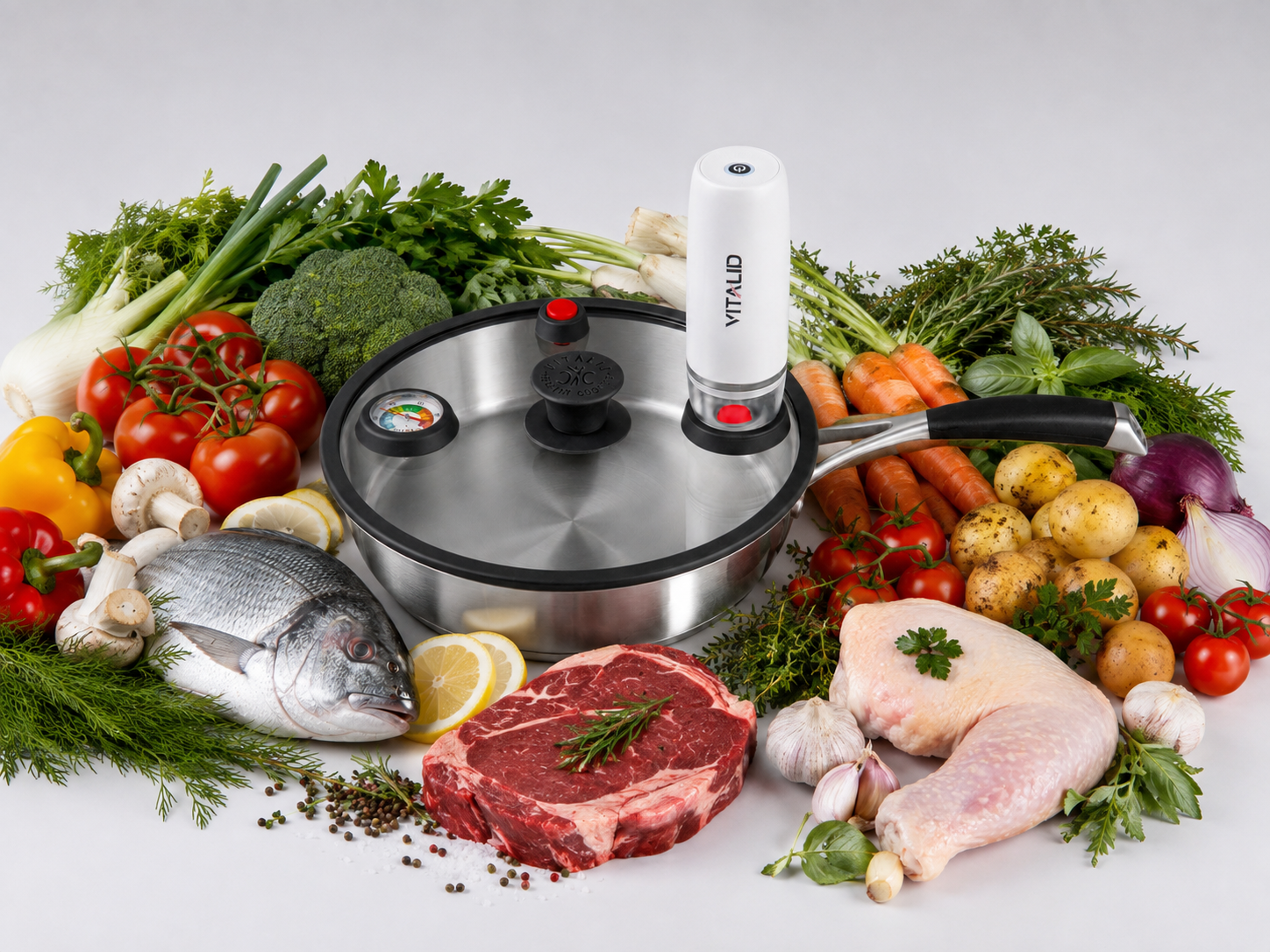
Every cooking method has its qualities, but also its limits, its excesses and its inconsistencies. VITALID corrects at the source what other systems endure or make worse. This is our patented cooking method, easily reproducible, controllable, economical and accessible to everyone, even beginners. This method creates a new, more stable environment inside its sealed chamber, where air, water, steam, pressure, gradients, heating intensity and exposure time are finally easy to control. It preserves far more of the nutrients, structures and authentic taste of each food. The vacuum naturally amplifies molecular agitation and so speeds up cooking, without really needing to change your habits. Cooking much faster while heating much less becomes naturally possible with vacuum, in the simplest way possible.
When the cooking method changes everything
The VITALID method does not replace cooking but first masters the heating. Its essential role: to cook accurately, simply and reproducibly, while respecting the authentic taste of the food. Recipes, sauces, seasoning and plating come afterwards: they belong to culinary creation and to each person's talent, complementing the cooking.
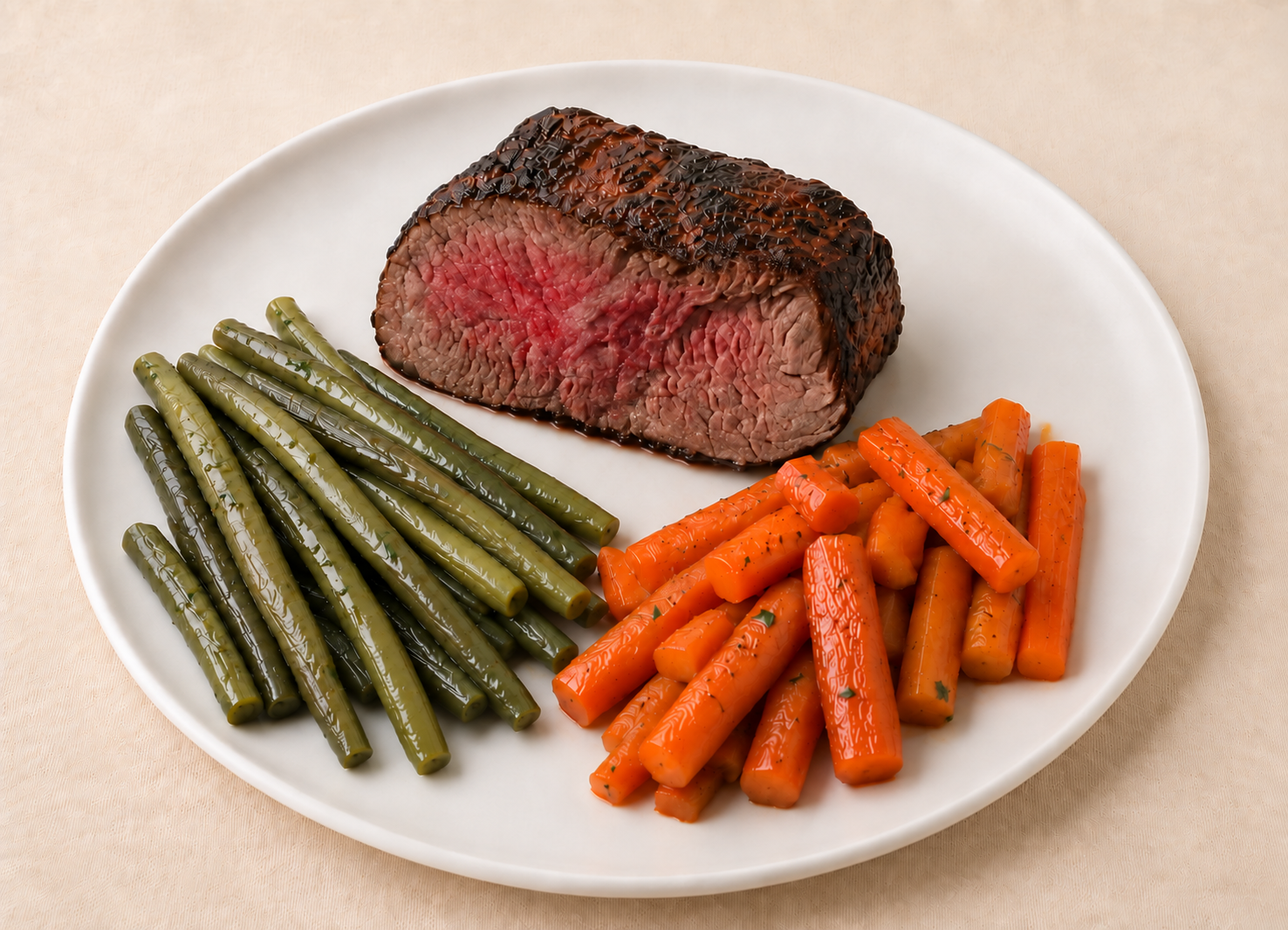
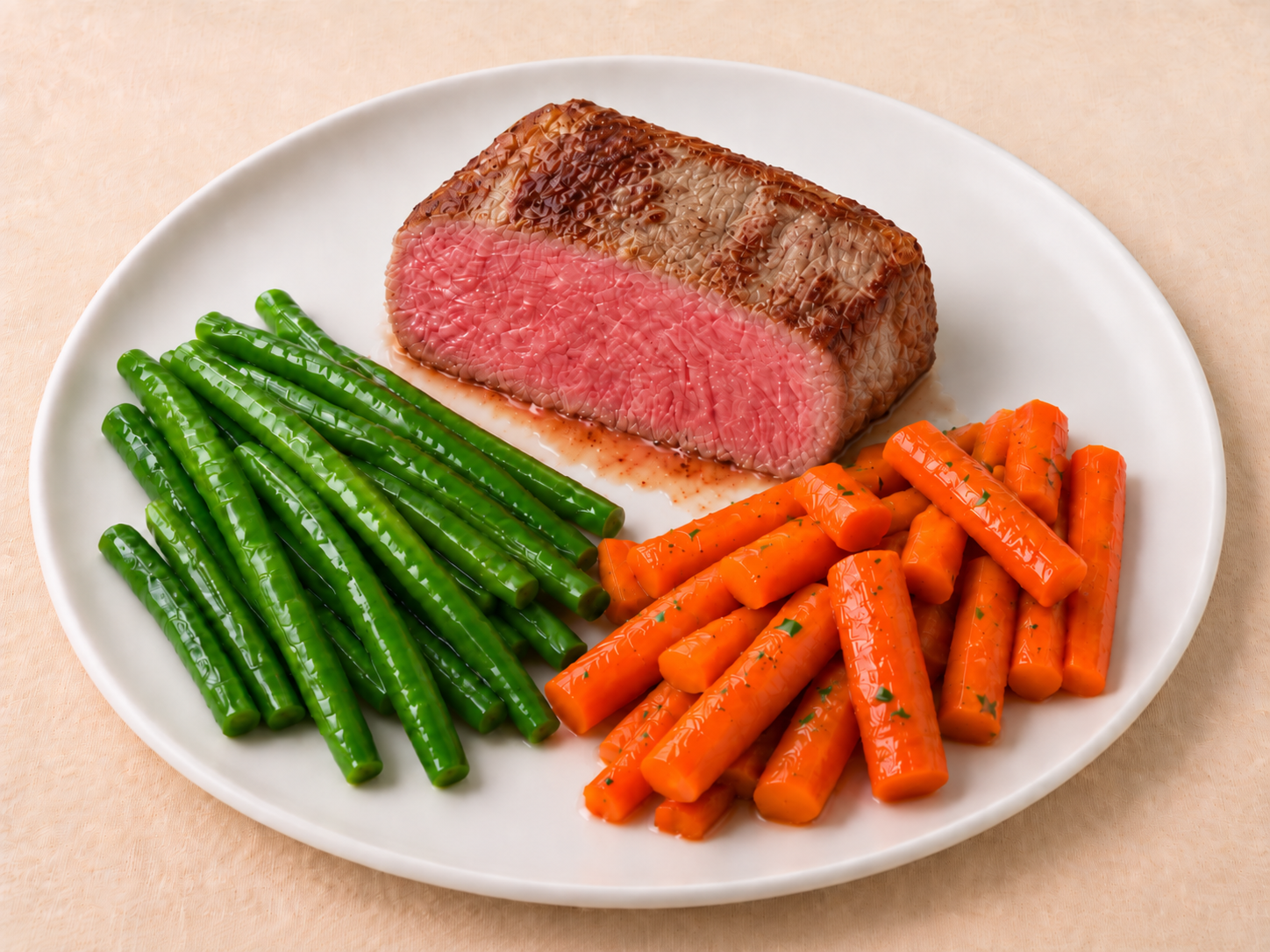
A result that needs no explanation.
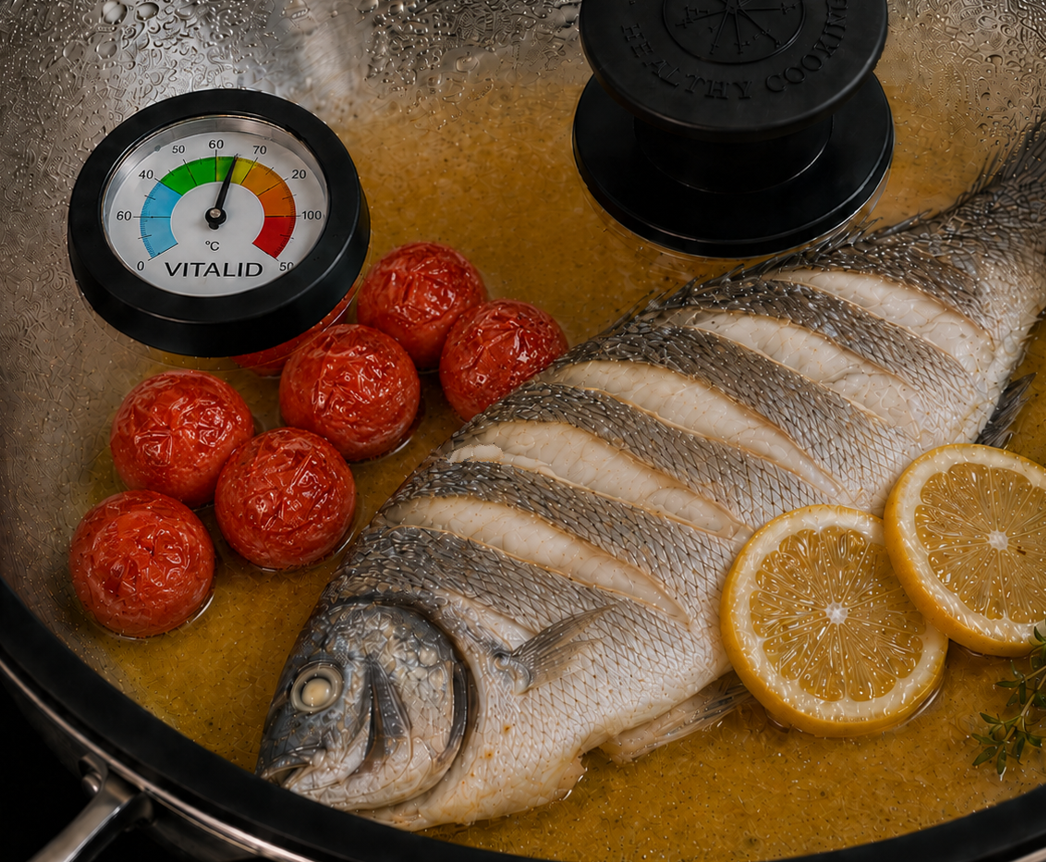
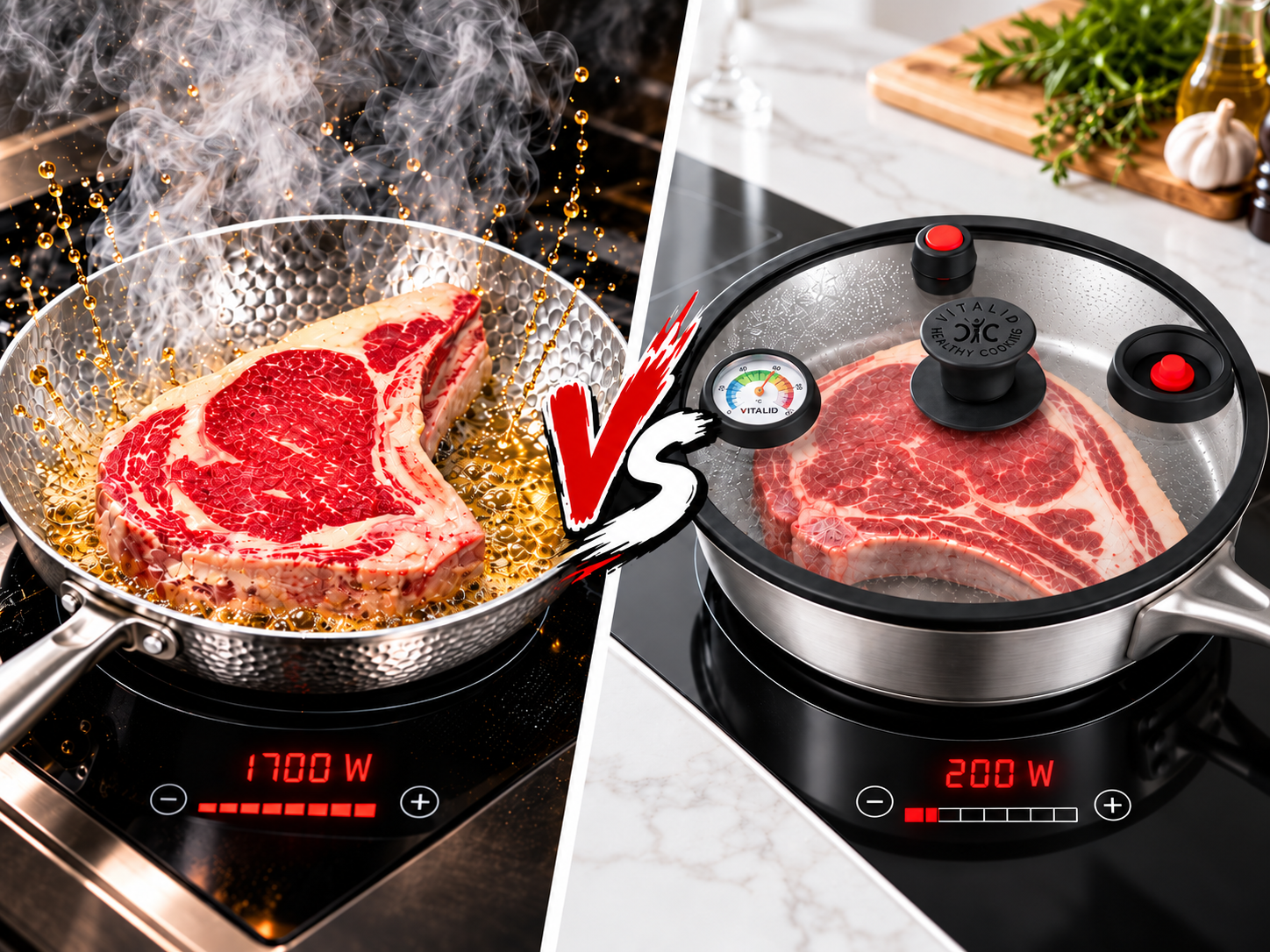
Here the difference is immediately visible: texture, juiciness, how the food holds together, drying out and colours speak for themselves.
Only one thing still escapes the image: the taste. That cannot be looked at, it is discovered when tasting.
Slide the cursor: the result can be seen. The taste has to be tasted.
Traditional cookingVITALID method
6 simple rules. Clear gestures. Zero complication.
The right choice every time
The most beautiful dishes are often born from a good vegetable, a fine cut of meat, a fresh fish. Provided that the cooking does not destroy the best of what they have.
That living quality that the eye cannot see, but that the body always feels.
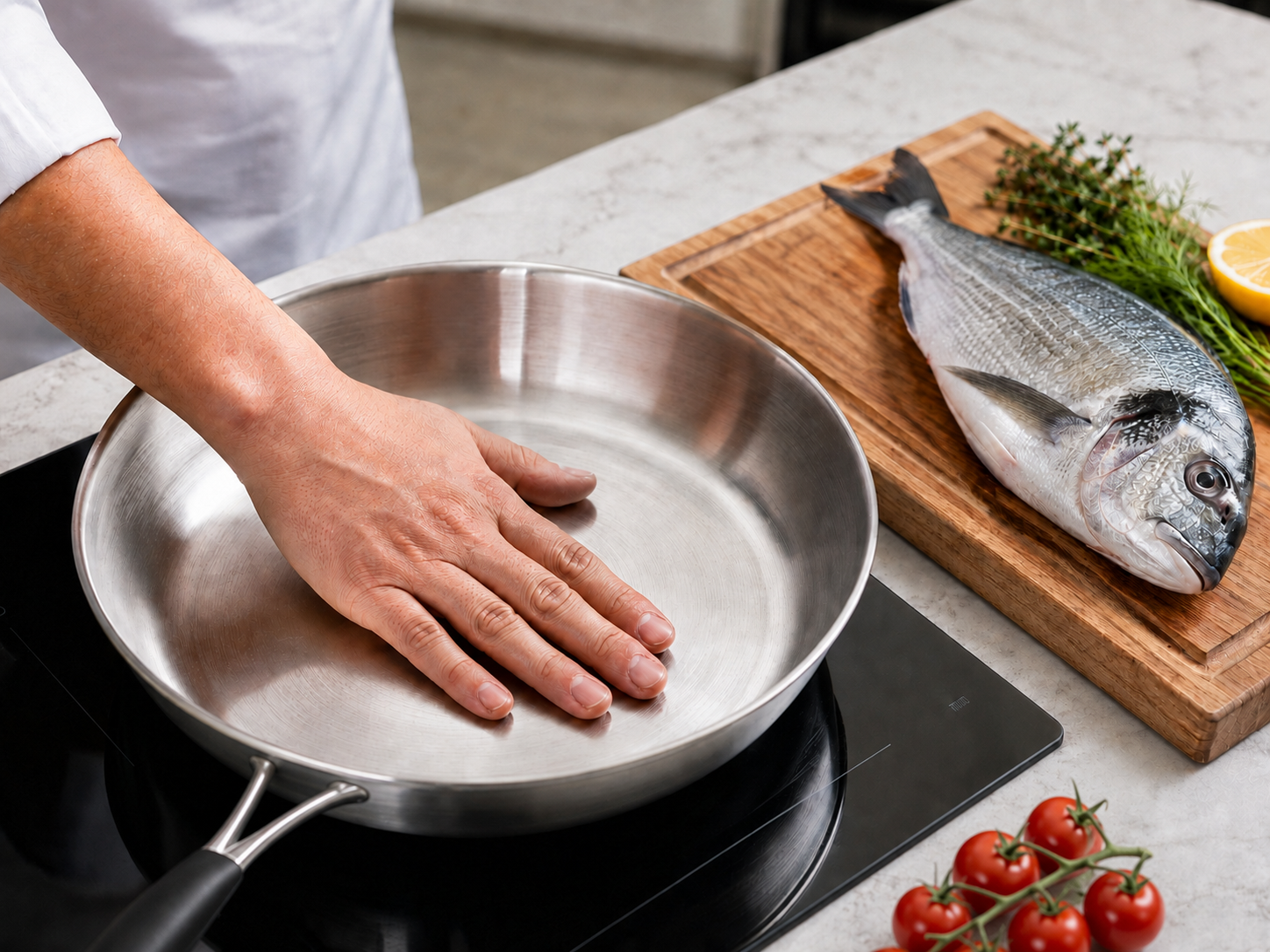
No preheating
With VITALID, you start cold. No need to risk overheating. Gentleness avoids stress and burning.
Caution is not a constraint, it is the foundation of all mastery.
Cold start
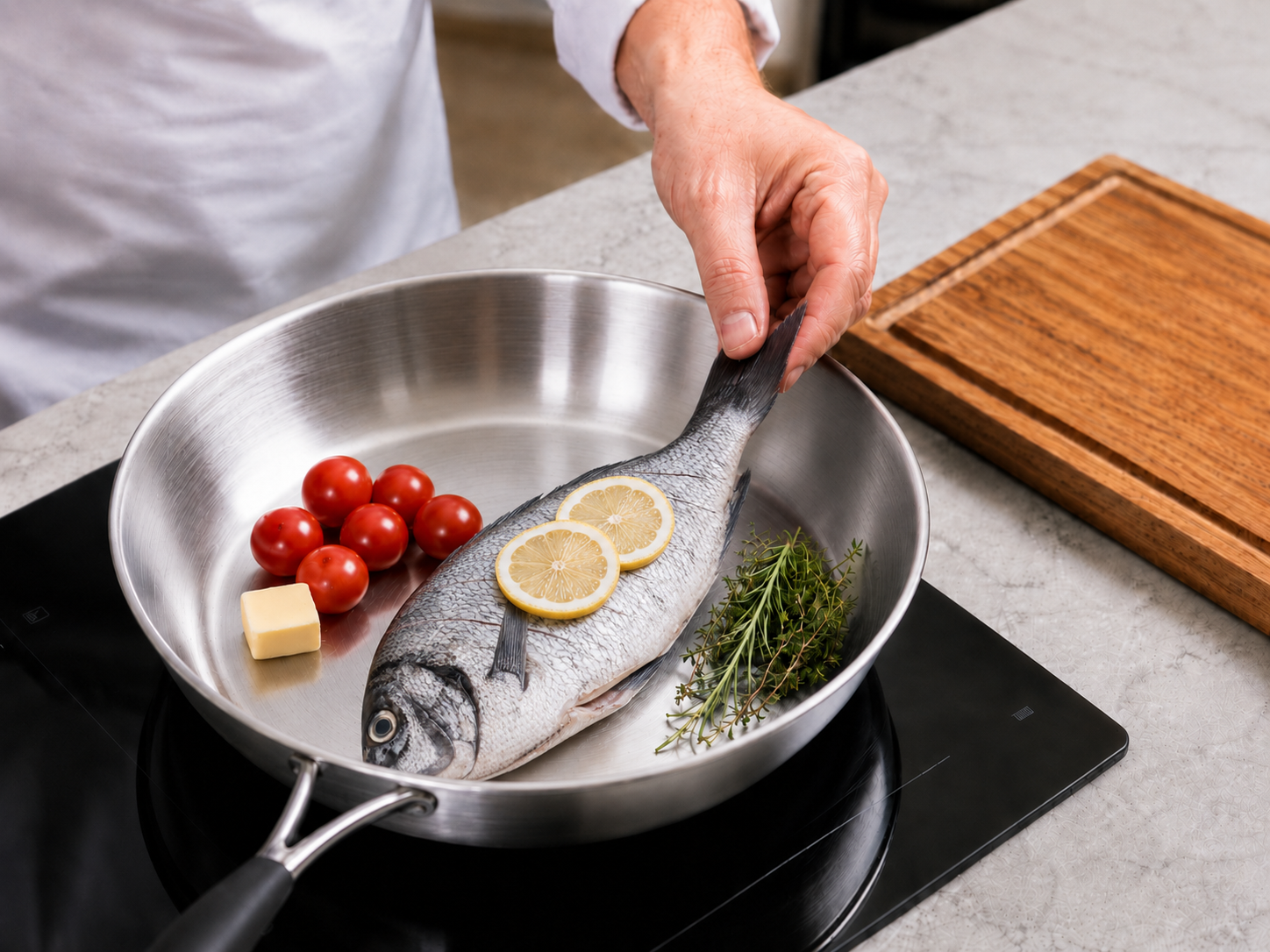
Place the food, preferably at room temperature, in the cold utensil, with or without fat, but always without adding any water.
Without thermal shock, the food will better preserve its texture, its juices and its nature.
Creating the sealed environment
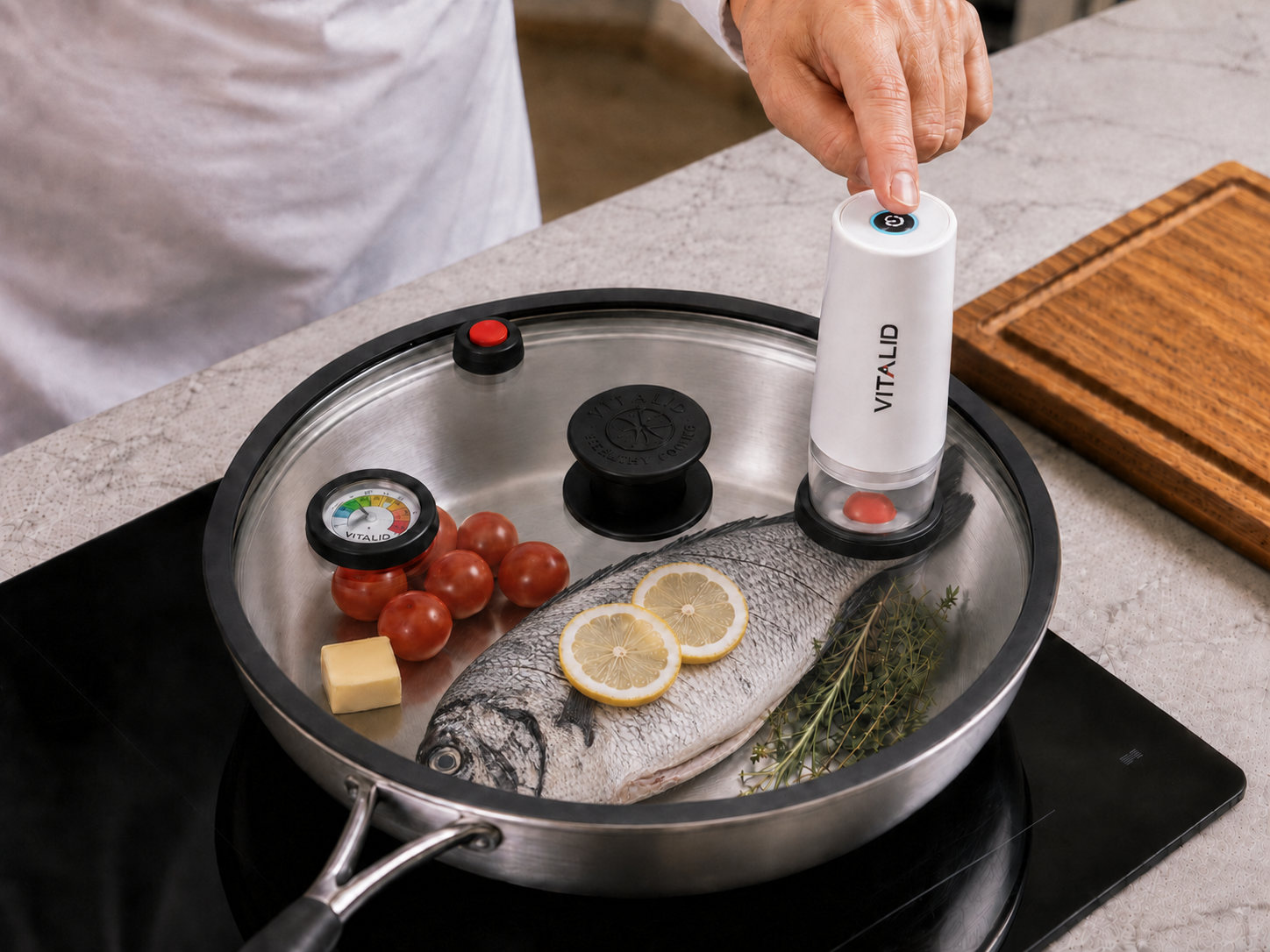
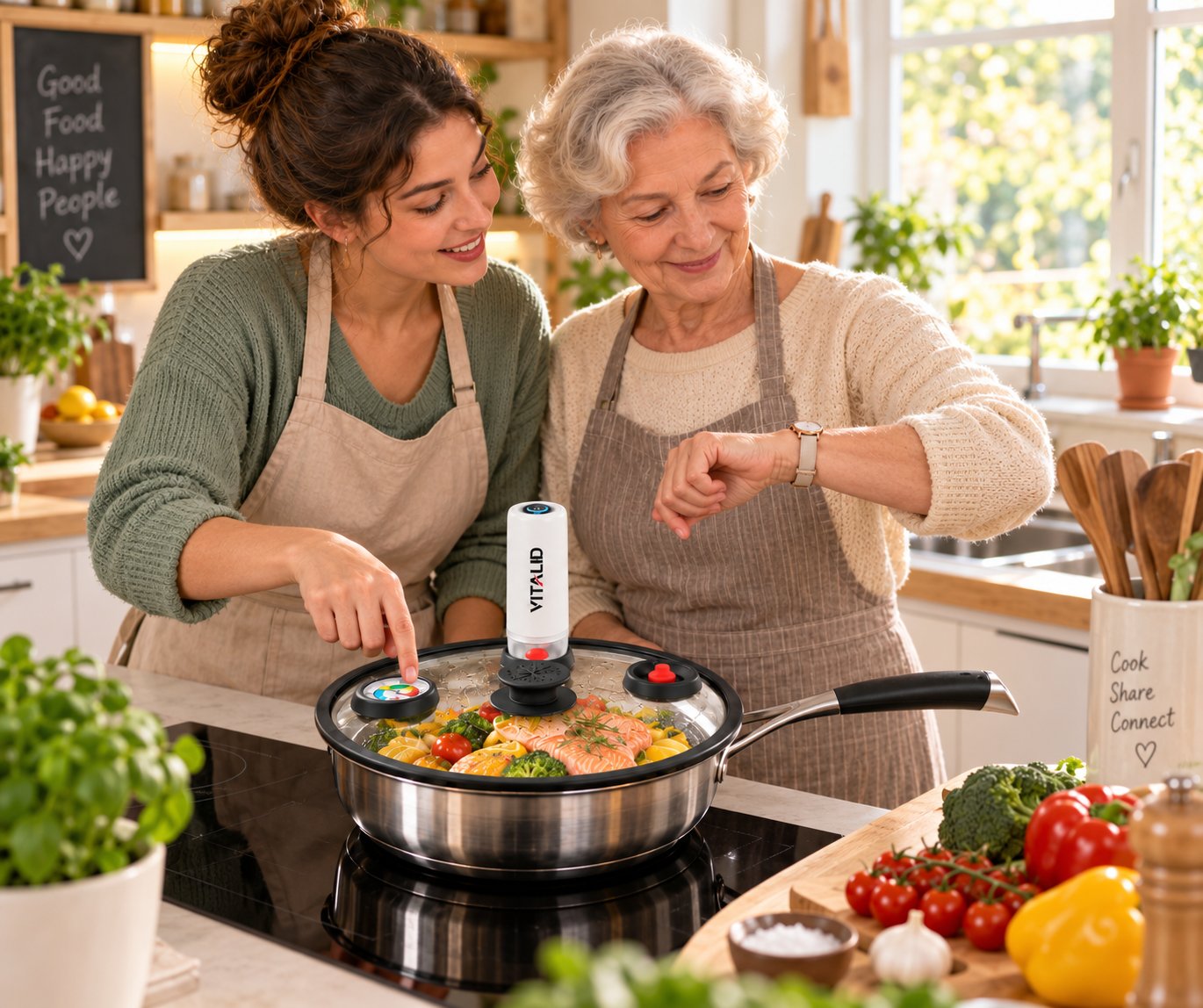
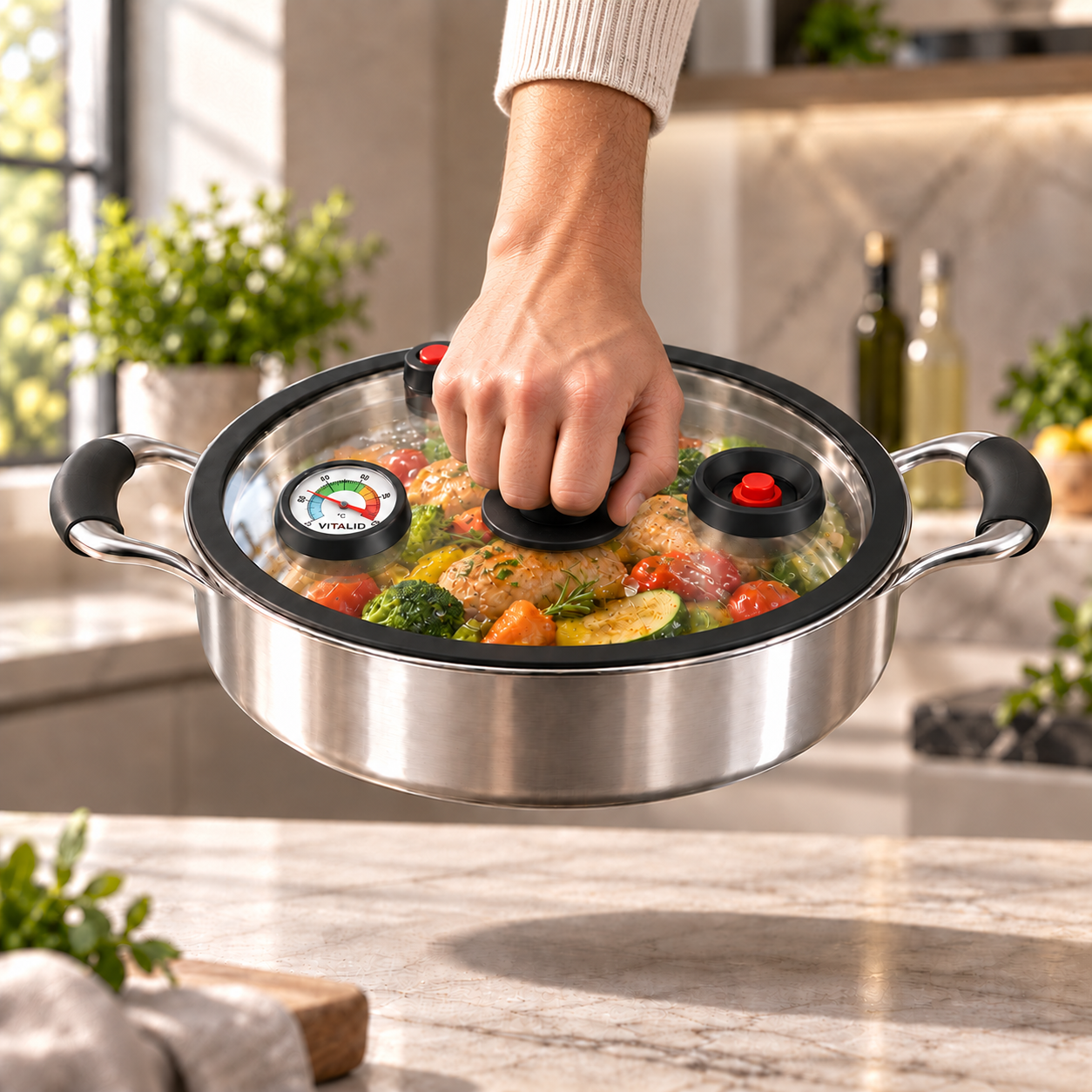
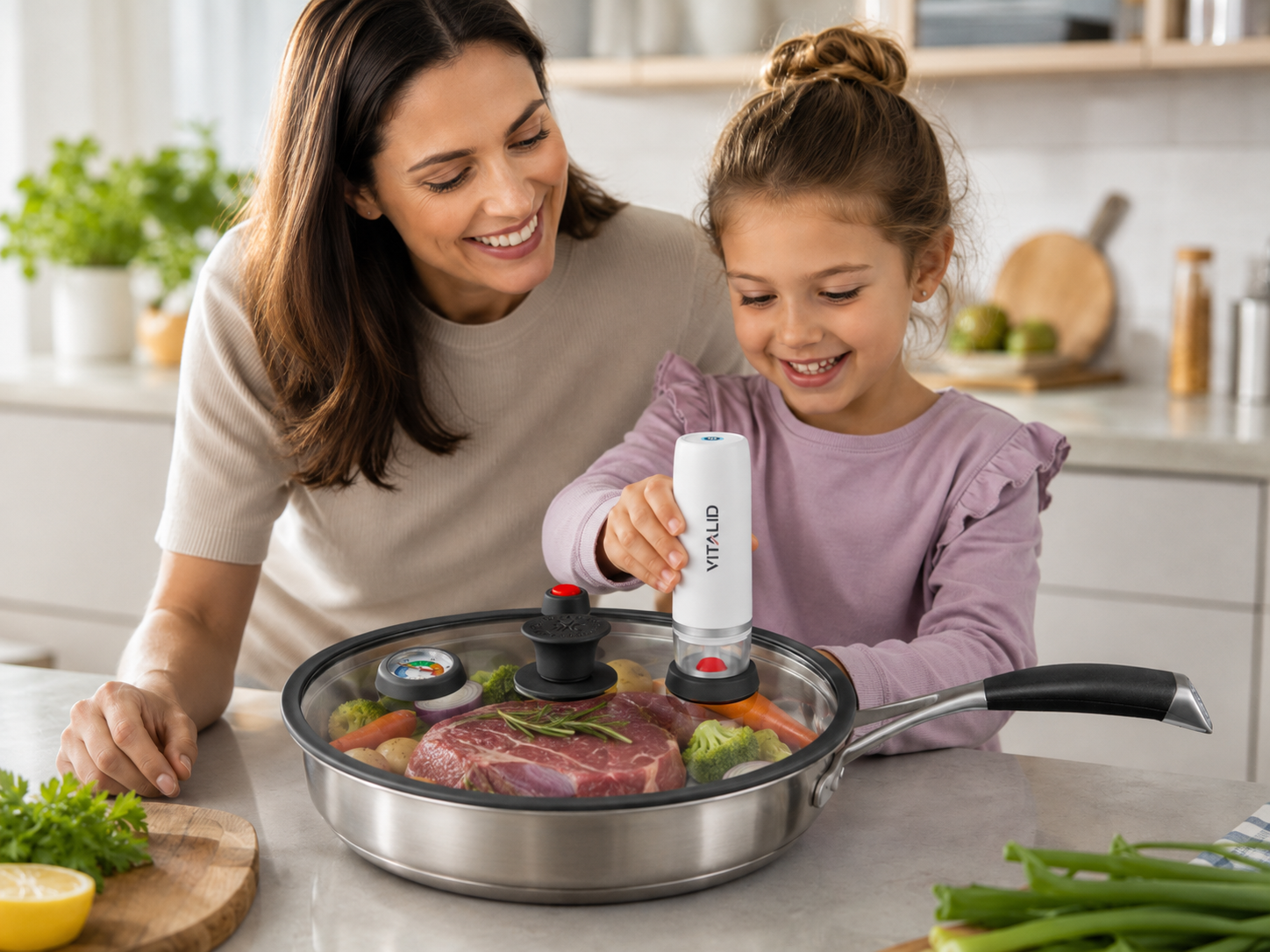
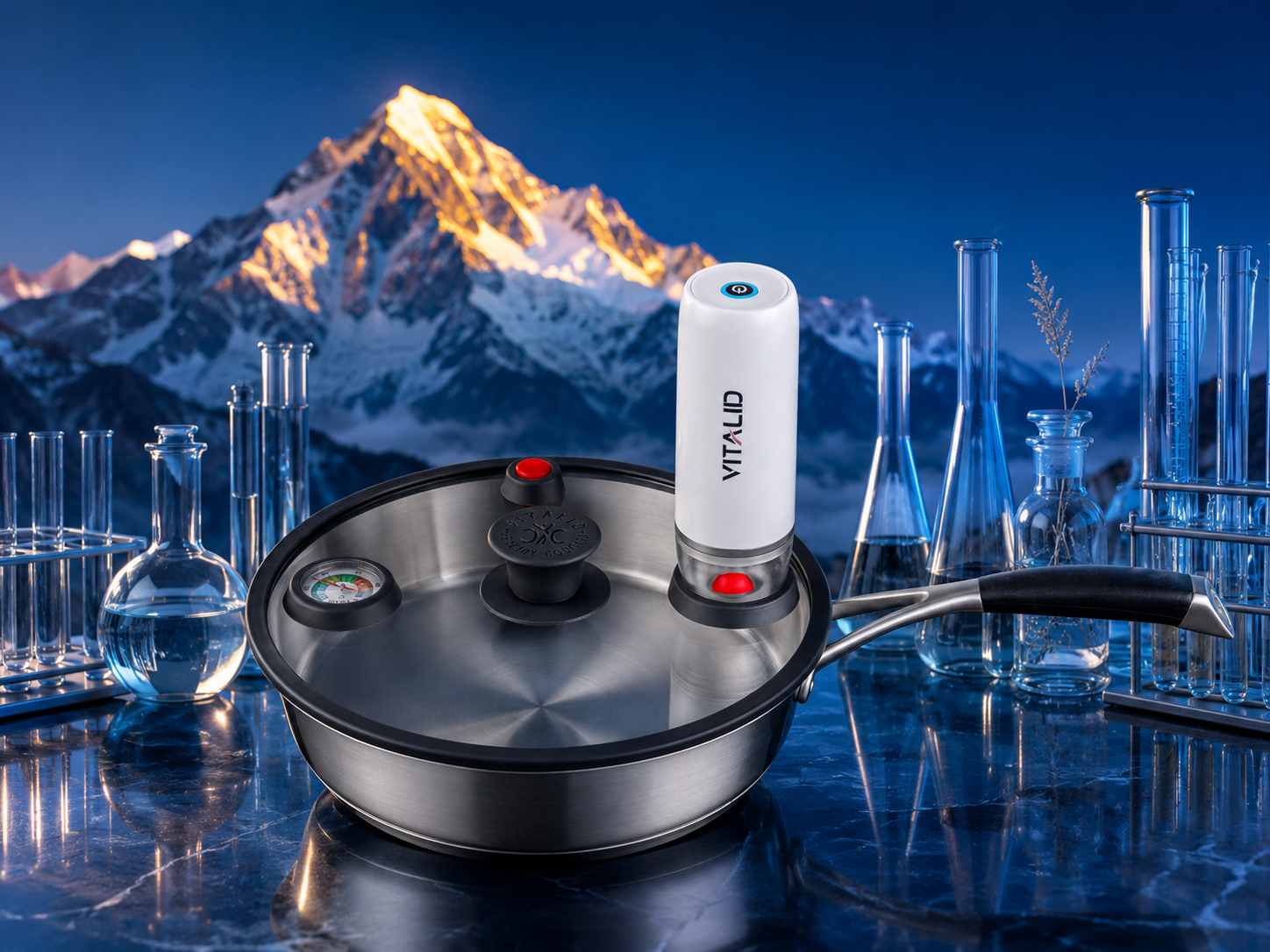
The lid is simply placed on, with no clips or locking. The pump creates and self-regulates the vacuum. A new cooking environment sets in.
The vacuum begins to reveal its full power.
A minimum of energy
Eight times less energy to support a gradual rise in heat. Here nothing burns, nothing dries out and above all nothing sticks. No unnecessary or destructive brutality.
A minimum of energy, for a maximum of control.
Never exceeding 65 °C
And that's it: nothing more to do, to stir, to turn over. No more gradient, the heat quickly penetrates to the core.
The cooking stays gentle and controlled.
Little effort and a lot of comfort
In a sealed environment under vacuum, nothing escapes: juices, flavours, vitamins, nutrients, tenderness, everything is refined inside, concentrates, becomes crisp-tender, is released, and the colours burst out.
When the air disappears, the intense and authentic taste returns and bursts in the mouth.
A method you can repeat endlessly
Accessible to the beginner, precise for the expert, and easy to reproduce, again and again with the same success.
With VITALID, success is no longer chance and quickly becomes a habit.
SETTING YOUR HEAT SOURCE PROPERLY WITH VITALID
Anyone who talks about cooking under vacuum at very low temperature must necessarily think of a cold start, low power and a gradual rise in temperature.
Nothing very complicated: VITALID simply asks for a little attention at the start, long enough to quickly find your bearings with your hob or burner, in 2 or 3 cooks.
The goal is simple: gradually reach the desired cooking zone without needlessly crossing the 60–65 °C barrier.
Step 1
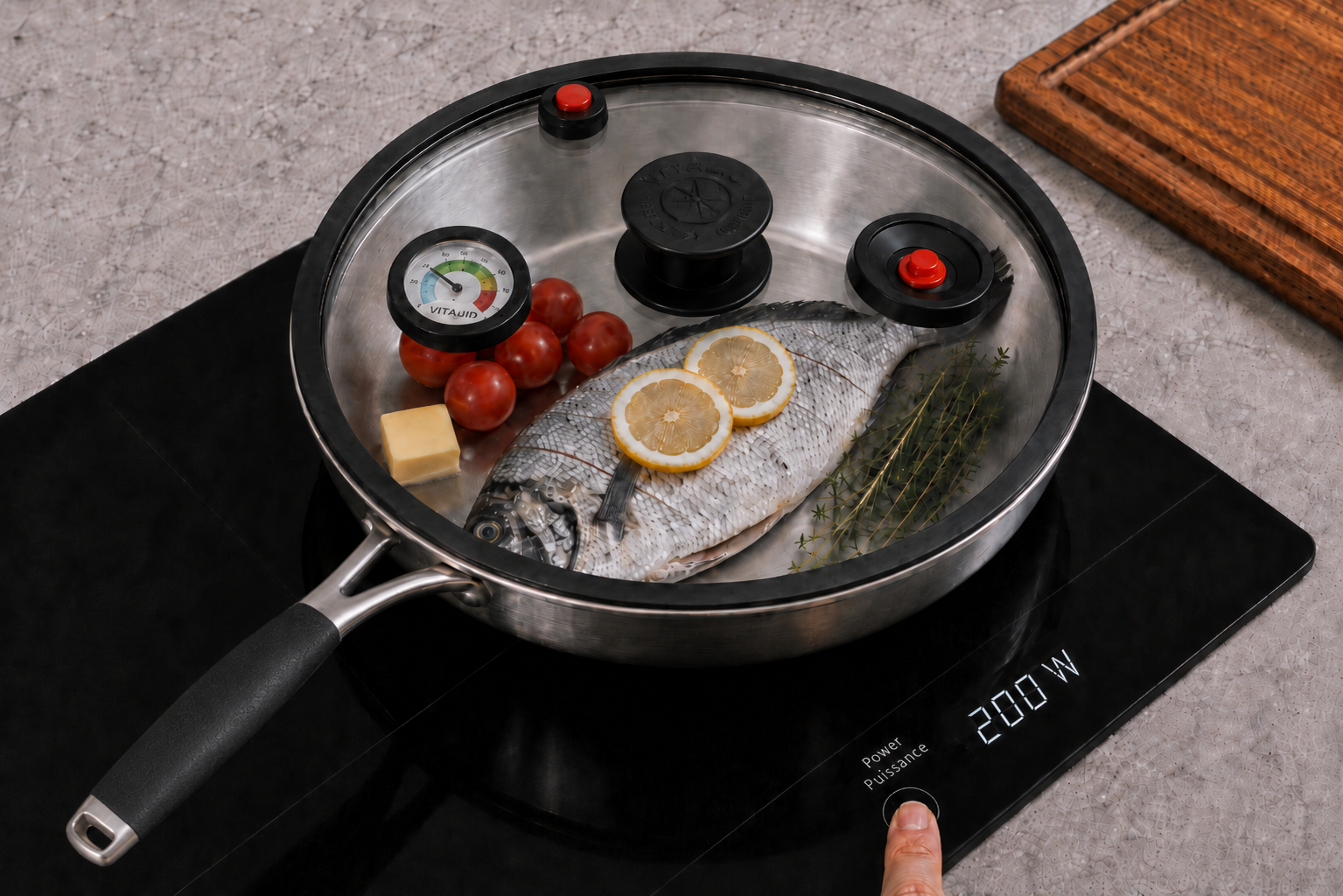
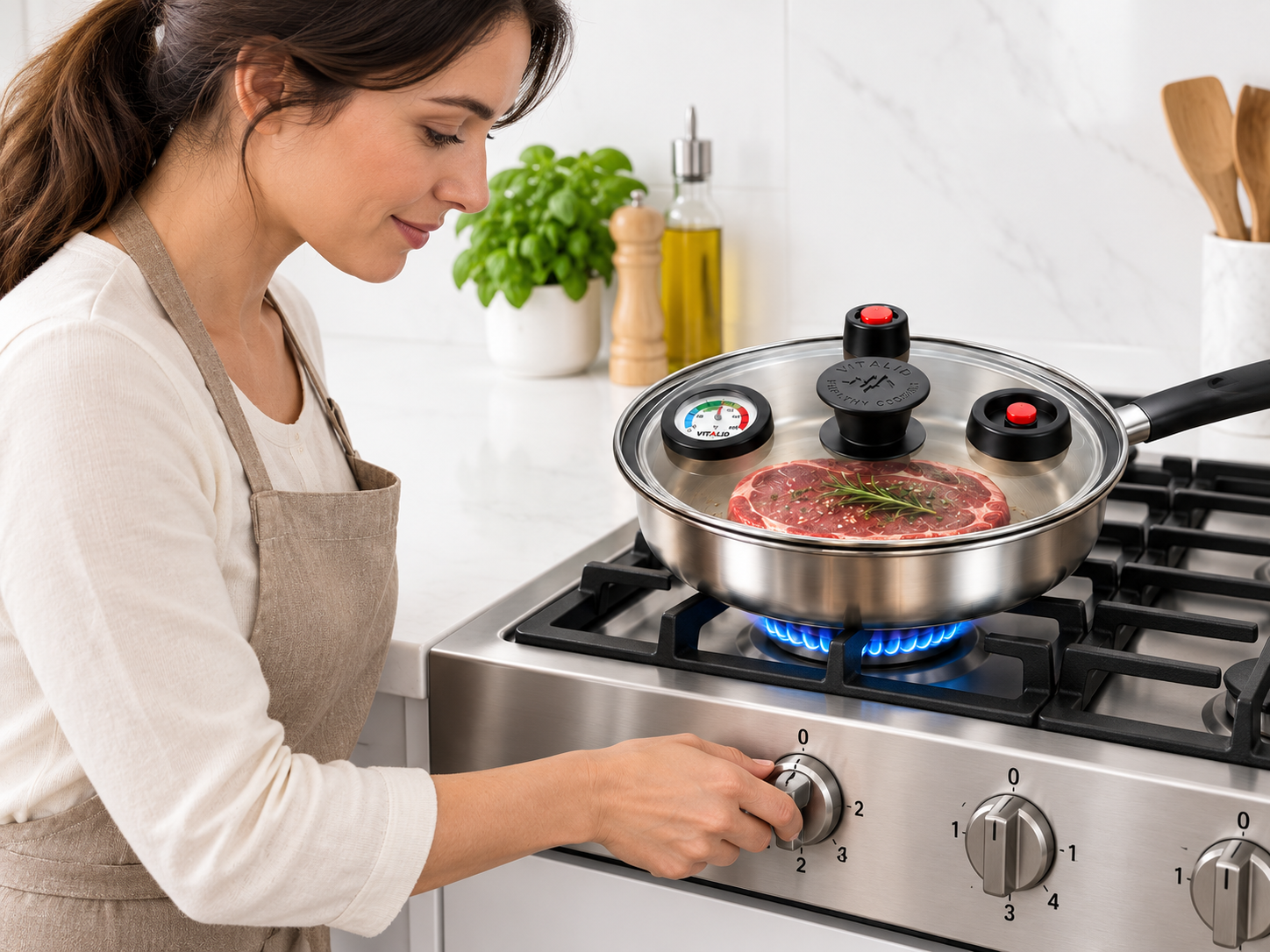
Start cold, without preheating, with about 20 to 30% of the available power, i.e. gas between 2 and 3, induction around 200 to 300 W.
Simply watch the thermometer, which should not rise too quickly or too slowly. Count on roughly ten minutes to reach 40–45 °C.
Step 2
At around 40–45 °C, reduce the power by about 30%: for example, gas between 1 and 2 or induction around 150 W.
Ideally, 60–65 °C will be reached after 15 to 20 minutes.
Do not try to exceed 60–65 °C.
Note: it is possible to cook with tealight candles, between 2 and 4 depending on their size.
For many foods of thin to medium thickness, once the temperature of the chamber has reached 65 °C, a large part of the cooking is very often finished. Depending on the food, its thickness and the result you want, finishing with the heat off is possible, but never for more than 4 to 5 minutes.
Important, according to the times observed: if the temperature rises too fast, lower the power. If it rises too slowly, increase it very slightly. If it goes above 65 °C, strongly reduce the heat, or even turn it off, then finish with the heat off if needed.
Important: adjusting the heating power is very simple. After two or three tries, everyone quickly finds their bearings with their equipment, because no hob and no flame reacts in exactly the same way. As with traditional cooking, the setting also depends on the food, its quantity and how full the utensil is.
The thermometer remains your best guide: follow it first. Also check, carefully, that the lid still seals properly and that the vacuum is maintained. Without vacuum, cooking is still possible, but it becomes much longer.
An imperfect setting never means that the cooking will be a disaster or the meal lost: simply adjust the heat, restore the vacuum and carry on cooking safely.
It is above all about changing a reflex: no longer heating hard from the start, but beginning gently. With VITALID, gentleness becomes the first guarantee of control, success and safety.
STICKING: A FALSE PROBLEM
Why does it stick?
High temperature + contraction of the fibres + expulsion of the juices + evaporation + concentration of the proteins = sticking.
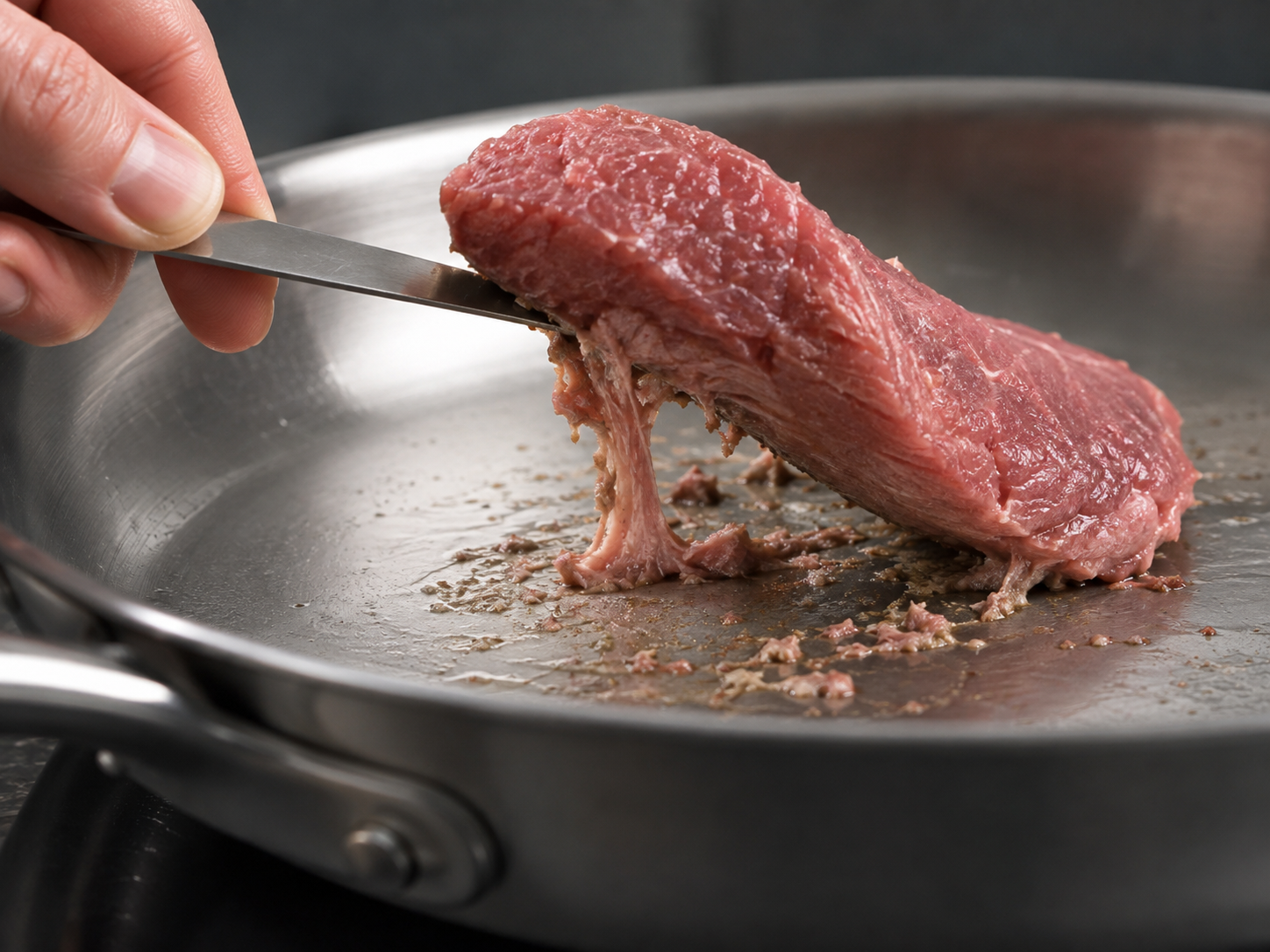
When raw meat meets a very hot surface, the surface proteins quickly denature and the muscle fibres contract. Part of the water held in the cells, together with soluble proteins and other compounds, then migrates to the surface.
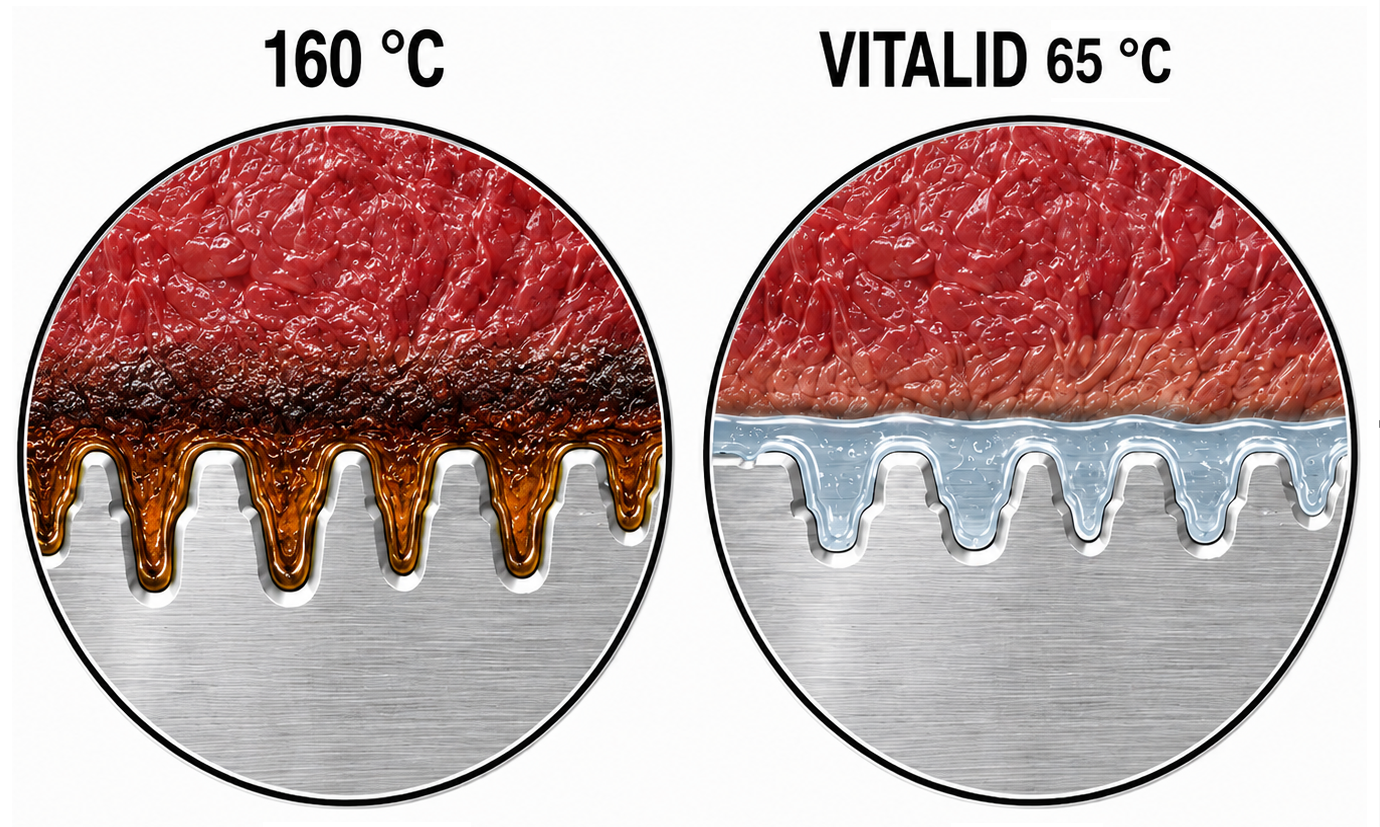
These juices, rich in particular in soluble proteins, mineral salts and aromatic compounds, end up between the meat and the metal. As the water evaporates, these compounds concentrate, coagulate on contact with the hot surface, penetrate its micro-roughness and promote sticking.
Then, gradually, the surface dries out, the proteins coagulate further and a crust forms. This crust becomes more rigid and can then gradually come away from the stainless steel. In other words: it sticks first, then the food releases once the crust is sufficiently formed.
That is why sticking is not just a matter of material: it depends above all on the contact conditions, the temperature and the surface moisture.
The water-drop test: an illusion of control
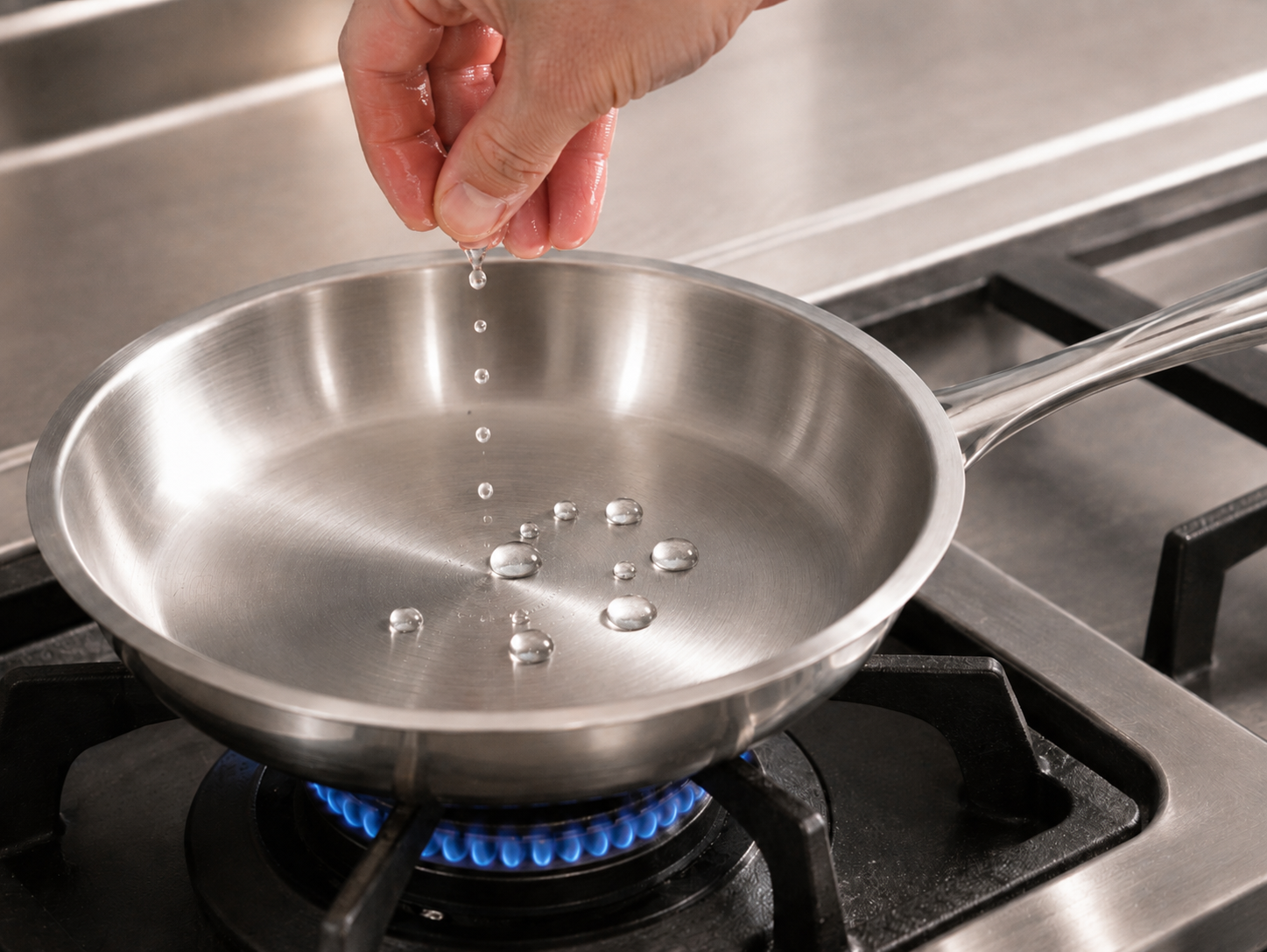
The water-drop test does absolutely nothing to remove sticking. It merely lets you roughly identify a high-temperature zone and speed up the formation of the crust that will then help the food release.
Presented as a solution to sticking, this test is above all a sales argument: it removes nothing, it only helps manage cooking already brought to high temperature.
A curious kind of control, that of overheating a pan and then trying to guess its temperature with a drop of water. This test only shows that the surface is hot enough to cause the Leidenfrost effect. It gives no precise temperature:
Not hot enough, the meat also sticks, but will release more slowly.
Far too hot, the cooking abruptly speeds up the transformations, the drying out and the risk of burning, while promoting the formation of unwanted compounds such as heterocyclic amines (HCAs) and, depending on the cooking method, polycyclic aromatic hydrocarbons (PAHs).
The NCI and IARC sources give pointers on the risks linked to heavily heated meats.
Removing sticking… with a non-stick coating
An effective commercial answer for selling a non-stick property, but one that moves the question to the composition, wear and ageing of the coating.
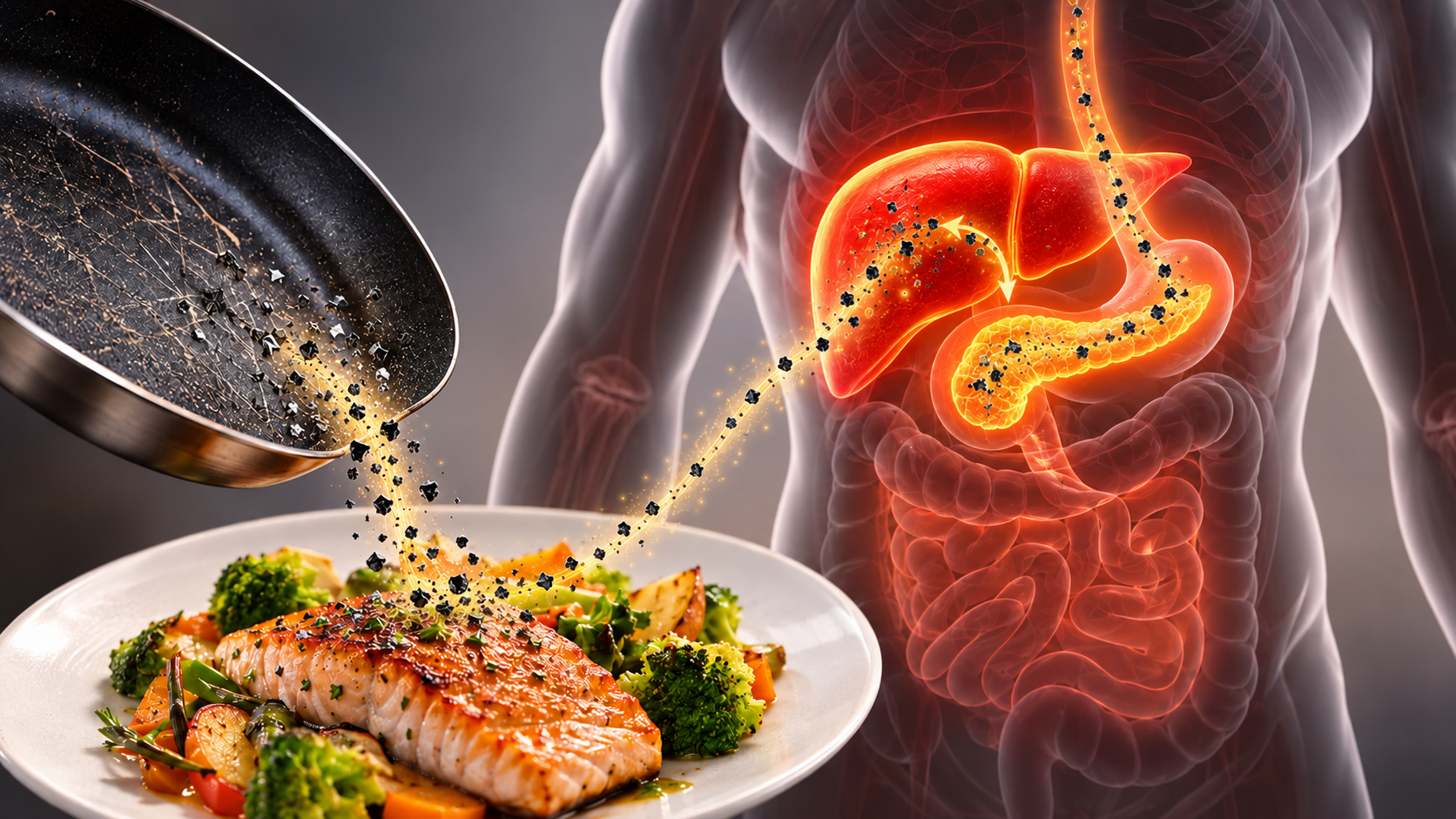
Problem solved? No, simply moved. And at what cost to health?
PFOA is now classified by IARC as carcinogenic to humans, while PFOS is classified as possibly carcinogenic.
Some research on pancreatic cancer still justifies further in-depth investigation.
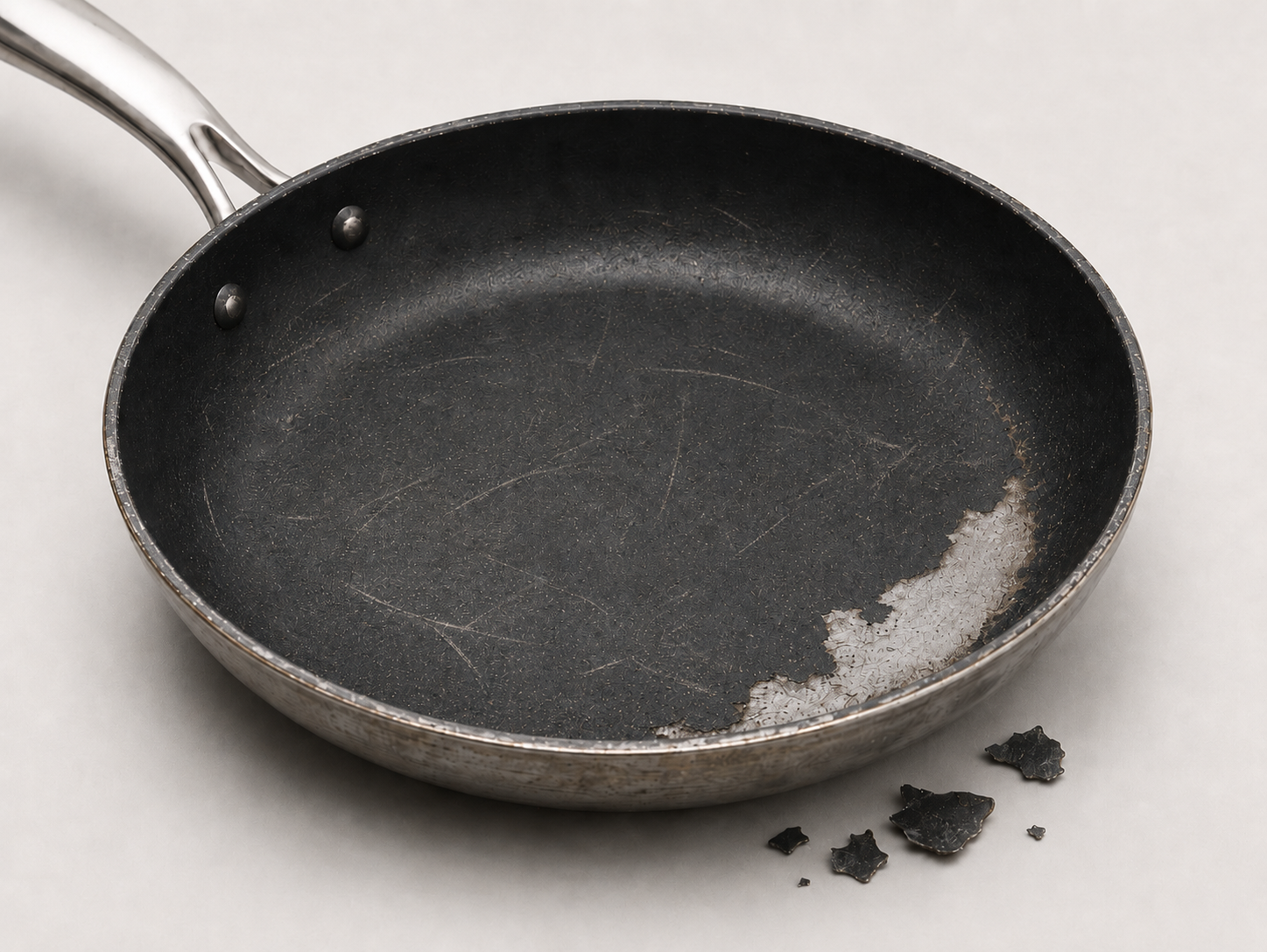
With scratches, wear, friction and ageing, particles can come loose and end up in food; a 2024 study notably identified PTFE particles from non-stick utensils in prepared foods.
Many grey areas remain about non-stick coatings: wear, abrasion, particle migration, the effects of binders, resins and other bonding systems used to fix these fluorinated, ceramic, mineral or other coatings.
Some studies have already shown migrations or alterations of these systems, without all the consequences being known.
Many questions remain, some already documented, others still waiting for answers…
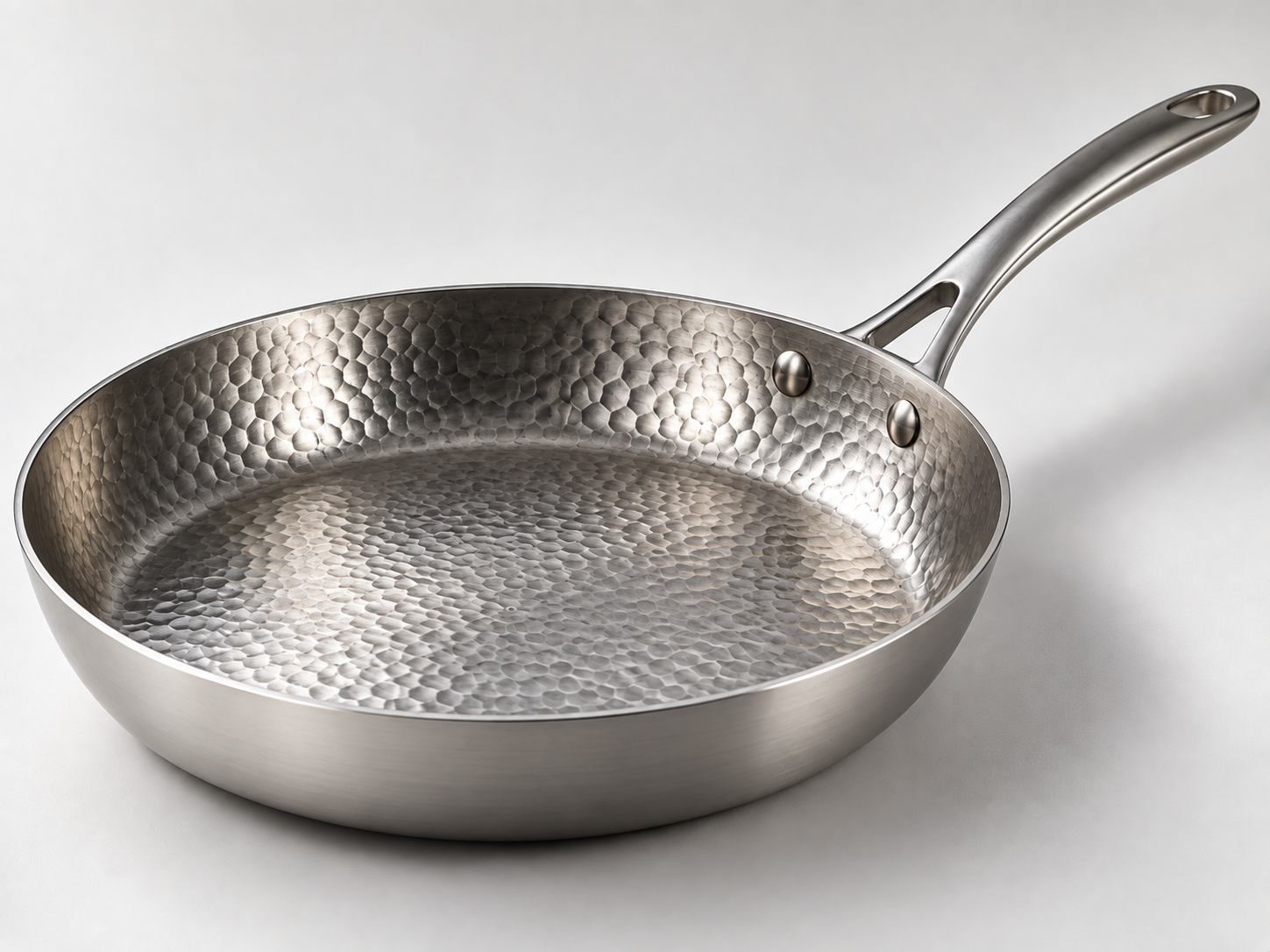
A new commercial arrival: titanium
Titanium is now arriving on the market with a logic quite close to that of successive coatings: new material, new promise, new way of standing out and entering the market. But changing the material changes neither the cooking principle nor the underlying causes of sticking.
The manufacturers themselves highlight the novelty of the material, the hammering, the hardness or the absence of PFAS as positioning arguments.
Titanium is now widely promoted as a new “premium” cooking material. Yet in many utensils it is not used alone: it is only a contact layer built into a multilayer structure, often made up of an aluminium core meant to spread heat quickly and an outer stainless steel layer for rigidity and induction. This is exactly the construction claimed by several makers of current titanium pans.
This multilayer construction is, however, much less suited to a chamber working under vacuum, where rigidity, homogeneity and mechanical stability become essential.
In VITALID, the material must not only be attractive or durable: it must directly serve the mechanical function of the method.
The constraint is not only thermal: the utensil must also form a rigid, stable and sealed chamber able to work durably under vacuum. That is why the choice of a 316L stainless steel body is first of all a manufacturing logic: a homogeneous, rigid and stable material, easy to form, weld and polish precisely, particularly suited to sealed constructions and to work under vacuum. Austenitic stainless steels, including 316L, are commonly used in vacuum equipment.
And above all, titanium does not remove sticking. Makers of uncoated titanium acknowledge this themselves: the surface is not non-stick the way a PTFE coating can be. Releasing the food still depends on preheating, fat, temperature and the moment chosen to turn the food.
Changing metal does not change the fundamental physics of cooking. Titanium, stainless steel or any other bare metal: when a food rich in protein or starch comes into contact with a sufficiently hot and dry surface, sticking remains possible.
This is precisely where VITALID changes logic completely. VITALID does not try to manufacture an artificially non-stick surface. The method acts on the conditions that cause sticking.
At very low temperature, under controlled vacuum and in a closed chamber, part of the water naturally present in the food remains available at the contact with the surface. Surface drying is very strongly limited, the juices stay more within the structure of the food, while the surface remains much moister. This avoids the classic conditions that promote protein concentration, drying out, surface coagulation and then their bonding with the metal.
This is why, in the VITALID method, sticking no longer needs to be fought with a coating, hammering, a texture or a “miracle metal”: the method prevents the conditions that cause it from taking hold.
The logic is radically different: questioning the very way of cooking. Other solutions work on the surface of the pan, VITALID works on the cooking itself.
Titanium changes the material; VITALID changes the method. The goal is to remove the very cause of sticking through control of temperature, time, water, steam and pressure. The material builds the utensil, the method creates the result.
And what about grilling? No, we haven't forgotten it.
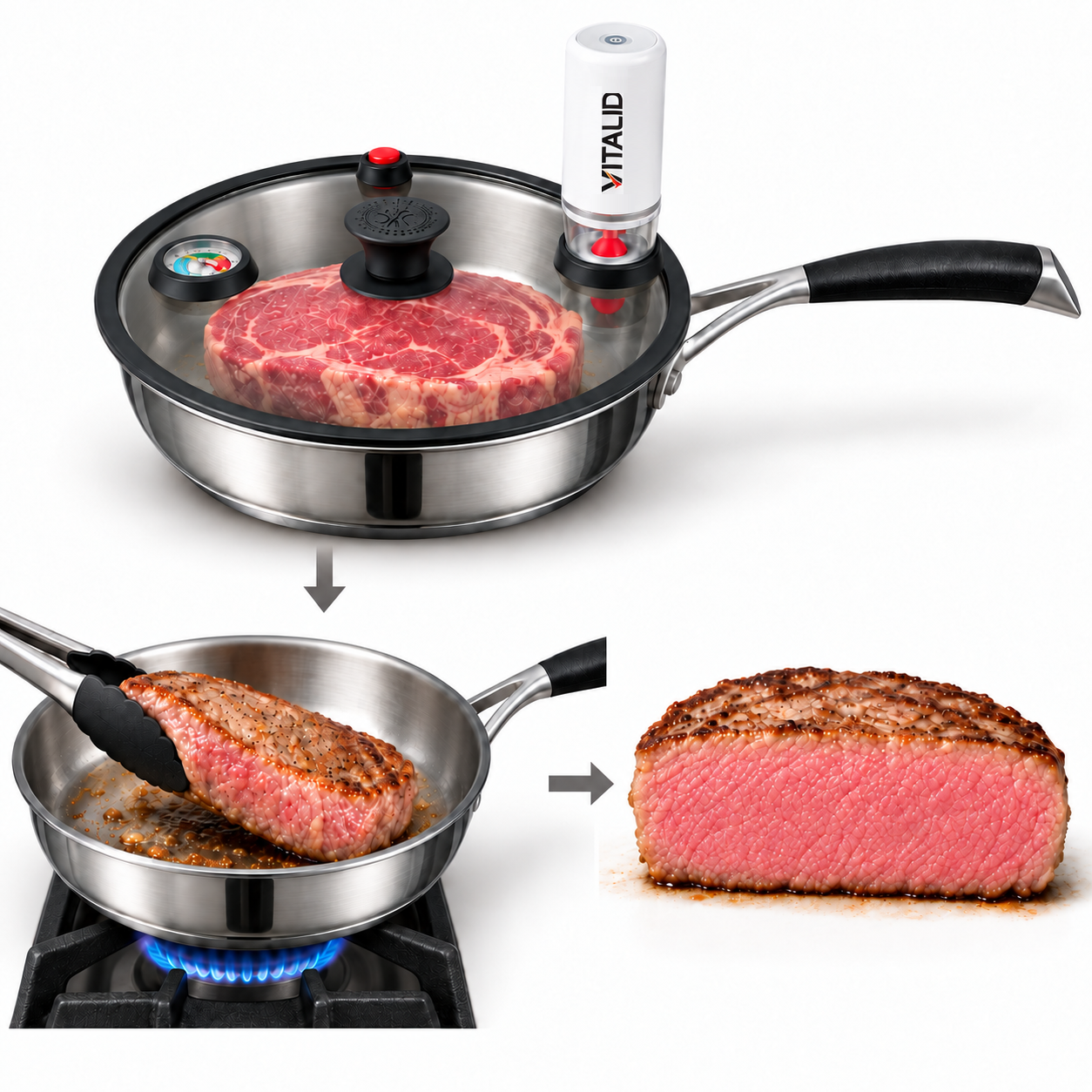
Rest assured, grilling hasn't disappeared. It simply comes in at the right moment: preferably as a finish.
In traditional cooking, from raw, strong heat is used to cook and to sear. With the VITALID method, it is only used to finish.
A meat already gently cooked through no longer reacts like raw meat when it meets high temperature. A large part of the proteins has already been gradually denatured, the structure has stabilised and the juices have been better kept in the food.
During the final grilling, the heat therefore acts mainly on the surface. It quickly triggers the Maillard reactions and gives the desired browning, easy to control in both duration and intensity. The heat no longer needs to penetrate deeply to cook the food: it essentially serves to create the surface finish you want.
Cooking and browning thus become two distinct operations. The finish creates crispness on the surface without subjecting the whole piece of meat to prolonged cooking at high temperature. You get a grilled, crisp surface while keeping a tender, juicy inside.
Crispness where you want it, without drying out everything else.
Understanding what is at stake in cooking
Since the mastery of fire, cooking has accompanied humanity. It has not only made food edible: it has transformed our relationship with taste, the way we eat, and also our biological and cultural evolution. Cooking is far more than a culinary gesture: it is a decisive step that shapes both our health and our pleasure.
Heat does not only act on flavours: it transforms matter. It coagulates proteins, dissolves collagen, concentrates or dilutes aromas, weakens vitamins, releases certain nutrients… but can also generate unwanted, even toxic compounds. Each cooking thus becomes a fragile balance between benefits and losses, sensory pleasure and health issues.
Understanding these mechanisms means giving ourselves the means to preserve what matters, to limit nutritional waste, to improve absorption and to support the body's vitality, while making dishes sublime.
What should be only pleasure and serenity has nevertheless become, faced with repeated warnings from the media and from scientists, a growing source of worry about overcooking and the hazardous materials used. And despite this, the finding is a sad one: nothing really moves. The debate stays focused on utensils: stainless steel, cast iron, copper, multilayers, coatings… each manufacturer promising to heat better, stick less, preserve better, sometimes even to purify or master the cooking with its equipment.
WHY DO WE NEED A FAIR AND SCIENTIFIC METHOD
Because a utensil does not cook
It simply transmits heat. What really cooks is the gesture, the technique and the method. A mere container will never cook in your place.
Yet it is precisely this heat that, beyond about 65 °C, needlessly degrades the sensory and nutritional qualities of food. So why keep heating more than necessary when both result and health are at stake?
We have known for a long time that air, water, temperature, time and the cooking environment directly influence taste, textures, nutritional qualities and the energy consumed.
But how can you heat less, cook faster and preserve more, without adding water or systematically resorting to steam? How can we reconcile what, until now, seemed irreconcilable? This is precisely the challenge VITALID set out to take up with its patented method of reverse cooking under vacuum at very low temperature.
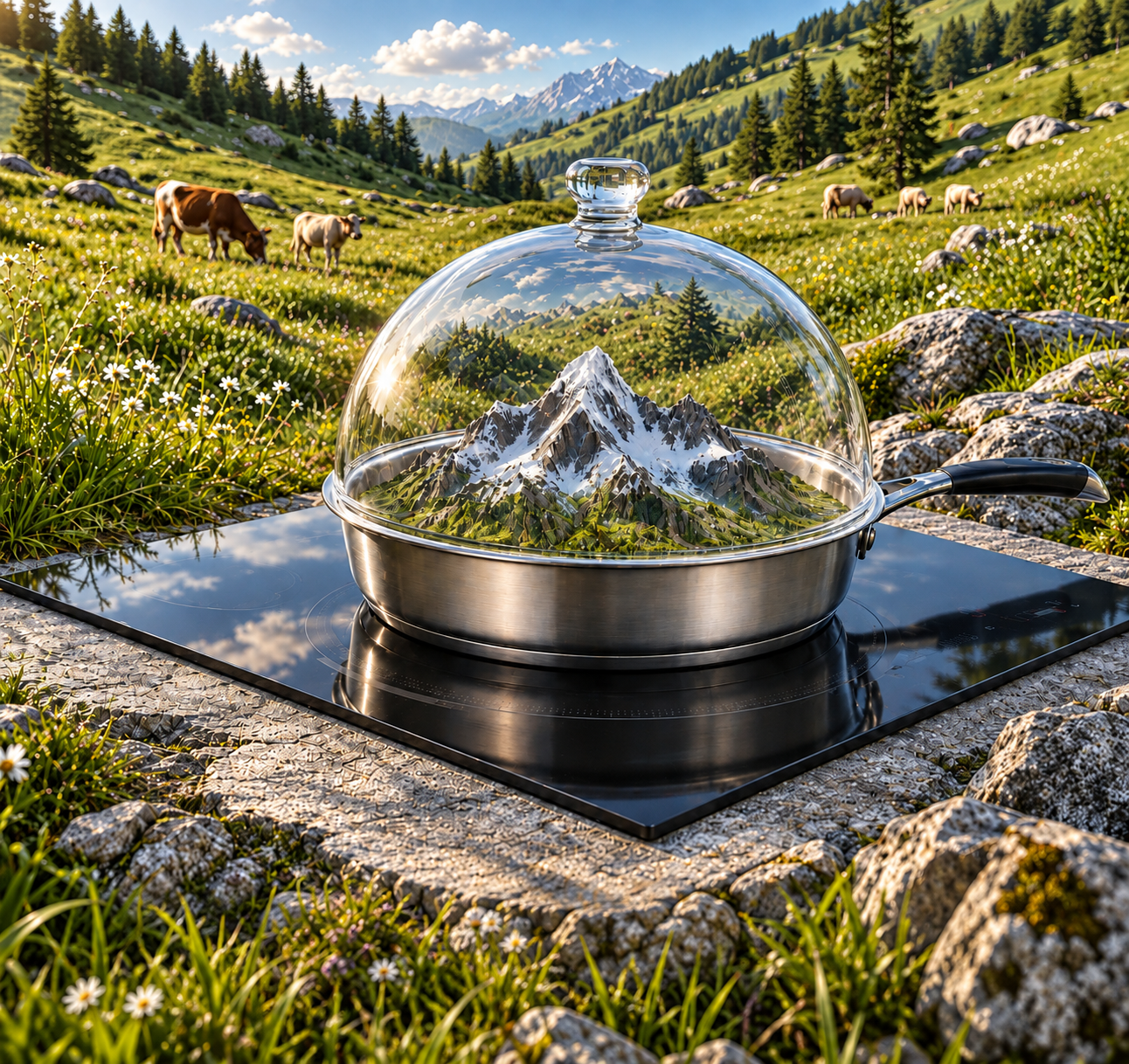
It was by observing a natural phenomenon well known in the mountains — where water starts to boil below 100 °C when the pressure drops — that the idea was born of applying an artificial vacuum around the food.
Between equipment and habits, temperature and cooking time, nature and observation, science and pleasure, tradition and innovation, the VITALID cooking method under vacuum at very low temperature proposes to give cooking back its full importance: that of a moment in which our love of food, our nutritional balance and perhaps the future of more conscious eating are all at stake.
Following gastronomy trends: favouring authentic taste and making processes easy to reproduce
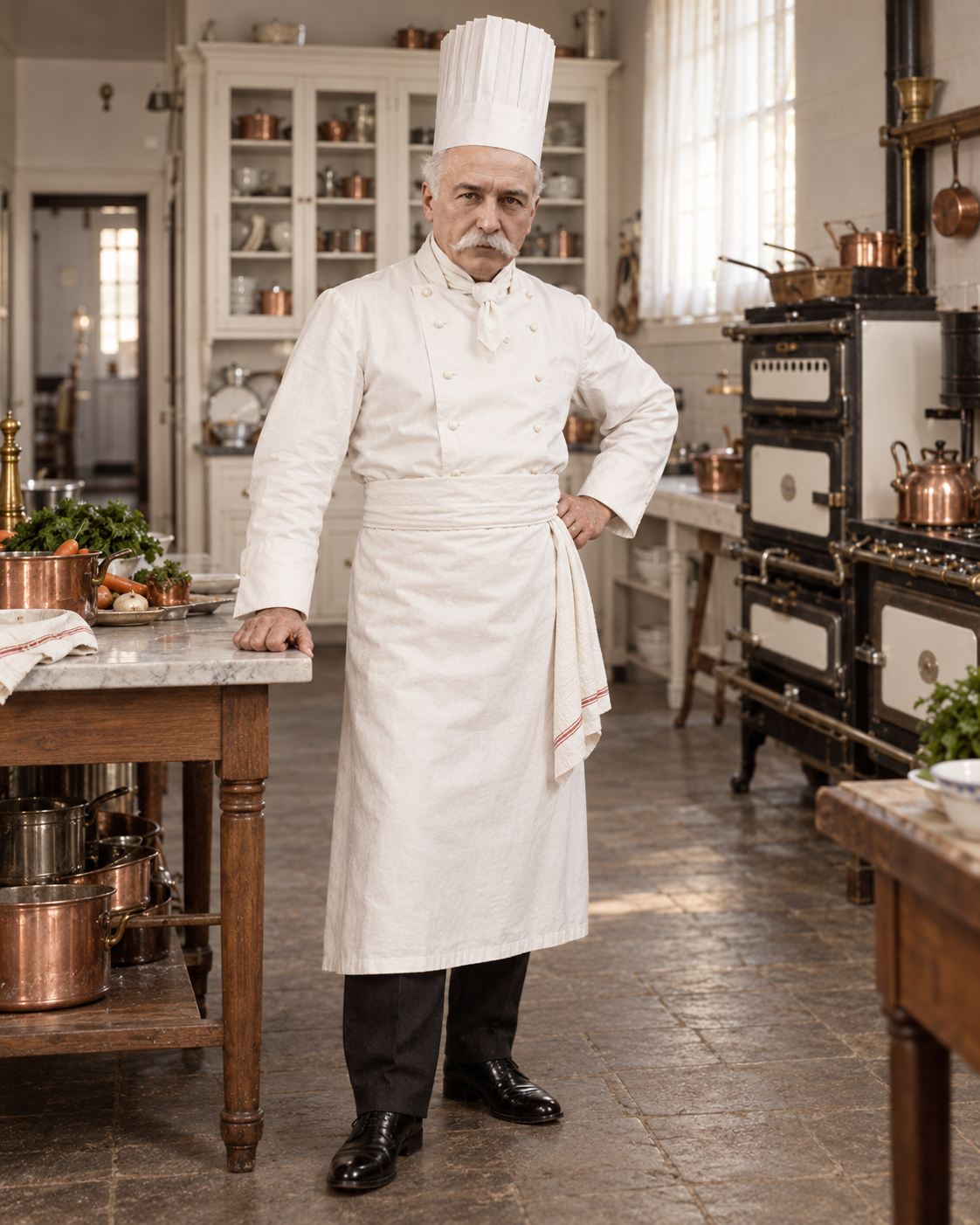
From the end of the 19th century, Auguste Escoffier was already seeking to simplify, to respect the product better and to look for its authentic taste rather than needlessly multiplying compensations, to rationalise and to make cooking more reproducible, without sacrificing taste.
Auguste Escoffier himself wrote that one had to “simplify again and again” and already sensed a more scientific cuisine, able to improve the nutritional and taste value of dishes. It is precisely in this evolution that VITALID stands today, offering a new technique designed to better preserve the true taste of each food.
This simplicity does not mean doing less well, but doing more accurately. It can be found among many great chefs: César Troisgros speaks of “clean flavours”, Alain Passard puts the product at the centre, Olivier Roellinger uses spice to reveal rather than mask, while Alain Ducasse seeks restraint and the preservation of the original. Philip Chronopoulos sums up this philosophy in a strong idea: the product comes first, the cook's gesture comes after.
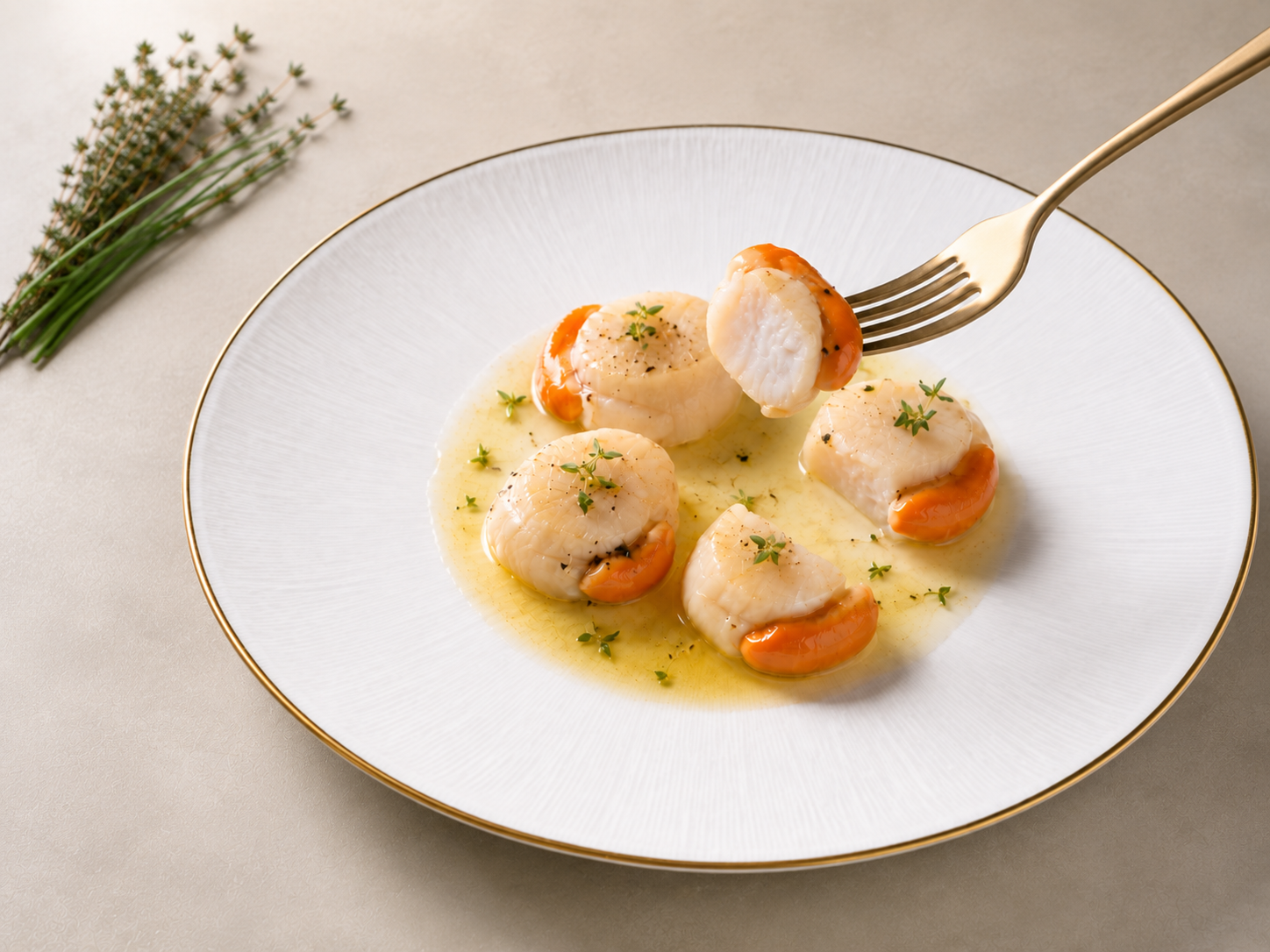
The example of Alain Ducasse with the scallop is revealing. Where it could once be accompanied by truffle and several other aromatics, he now seeks a much lighter expression, even cooking it simply in butter. Taking away what surrounded the product, provided that it still keeps enough of its true original taste to stand on its own.
That is the whole difference between enriching a taste that is already present and rebuilding a taste weakened by cooking. A herb, a spice, a jus or a sauce can beautifully complement a food whose identity remains perceptible. But when cooking has strongly dulled it, they must take up more space to give it character again. In one case, the cook works with the product; in the other, they risk having to work in its place.
A question therefore arises: what is the point of selecting a line-caught fish, a breed, a variety of fruit or vegetable, a terroir, a producer, a method of rearing or growing, a particular diet or maturation, if cooking flattens out what was chosen precisely for its uniqueness?
This search for authentic taste nevertheless imposes another requirement: reproducibility. In open cooking, the slightest change in temperature, duration, humidity, air circulation or evaporation can alter the result. Conversely, a closed, sealed environment, with much less air and no added water, strongly limits outside influences and makes it possible to recreate much more stable conditions. This is precisely where VITALID brings a new answer, intervening even further upstream, with its revolutionary method.
When the cooking truly preserves the original taste of the product, the aromatic recovers its true function: to accompany, underline, reveal, and not to compensate for what the cooking has made disappear.
Auguste Escoffier, considered one of the founding fathers of modern cuisine, enjoys exceptional historical authority among contemporary chefs. He had already announced the essentials by predicting that cooking, while remaining an art, would become more scientific. But one key was still missing: vacuum. By adding it, it becomes possible to overcome certain physical constraints of traditional cooking and to reconcile what seemed contradictory: cooking faster while heating much less, while better preserving the authentic taste and the nutritional richness of food.
VITALID is not meant to make your recipes for you. Its first role is to master the cooking and to return to the fundamentals of gastronomy: simplicity, consistency, reproducibility and respect for authentic taste. The recipe, the seasoning and the finish come afterwards, as the culinary expression of this mastered cooking.